Blog
Austin's Complex Bottom: The Data Behind the Reset
Austin's housing market has reset on price, absorbed most of its pandemic-era supply wave, and cut its future pipeline to a fraction of the peak. Every figure below is the latest published as of November 5, 2026, and links to its source.
Key findings
- $421,000. The Austin metro median home price in September 2026, 23.5% below the $550,000 peak of April and May 2022. (Unlock MLS)
- 14.4%. How far the City of Austin median ($570,958) sits below its May 2022 record of $667,000. The urban core corrected far less than the metro. (Unlock MLS)
- 97,000. Market-rate apartments Austin added since the start of 2020. Nearly 40% of the metro's apartment properties are less than six years old. (RealPage)
- 14 for every 10. Over the past 12 months, renters absorbed 21,237 apartments while 14,825 were completed. (CoStar data via Matthews)
- 2.5 quarters. The entire remaining apartment pipeline, 13,543 units, equals about two and a half quarters of demand at the current pace. (Matthews)
- 79%. How far metro apartment permits through August 2026 sit below the same period five years ago. (CRE Daily, citing The Real Deal and Austin Business Journal)
- 1.8 months. Lease inventory for houses, townhomes and condos across the metro, down from 2.9 months a year ago. Active rental listings fell 27.6%. (Unlock MLS)
- First rent gain since 2022. Austin apartment rents rose 1.3% in Q2 2026, the first quarterly increase since fall 2022. (RealPage)
- Two Terafabs. Tesla's Terafab research fab is under construction at Giga Texas in Austin. The full-scale plant, a $16.8 billion first phase with 3,000 jobs, will be built in Grimes County. (Manufacturing.net)
- 7.40%. The 30-year mortgage rate on October 8, 2026, the highest since November 2023. Metro closed sales fell 14.8% in September. (Freddie Mac, Unlock MLS)
Lines to quote
Attribution: Dylan Peters, General Partner, Reawaken Capital.
- "Austin is not breaking. It is at a complex bottom. Prices have reset, the supply wave has crested, and demand never left. The one thing missing is cheap money."
- "For every 10 apartments Austin delivered in the past year, renters filled 14. That is what the end of a glut looks like."
- "The glut was decided in 2021, when developers pulled permits for more than 25,000 apartments. The next shortage is being decided right now, with apartment permits down 79%."
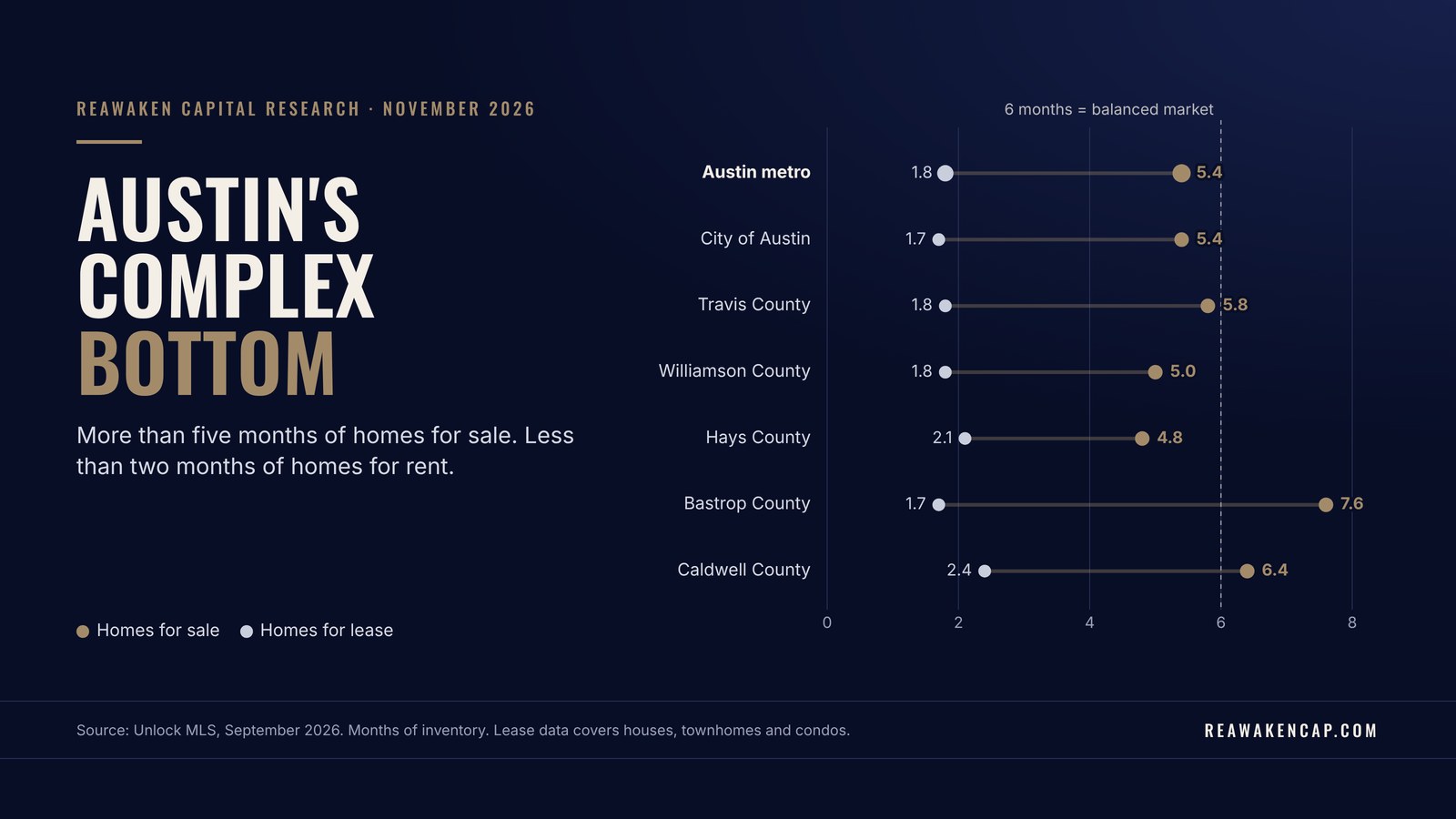
- "Austin has more than five months of homes for sale and less than two months of homes for rent. That gap is the opportunity."
- "Terafab's factory is going to Grimes County. Its research fab and Tesla's headquarters are in Austin. Housing follows paychecks, and the paychecks are still landing here."
Executive summary
Austin has finished most of its housing correction and is now waiting on interest rates, not on Austin. We call this a complex bottom. Prices and rents have reset, the record apartment wave has largely been absorbed, and the pipeline behind it has collapsed. What is still missing is affordable financing, which is holding down sales volume.
The for-sale market reset first. The metro median is $421,000, 23.5% below the 2022 peak and up 1.4% from a year ago, with 5.4 months of inventory. Inside city limits, prices are up 4.2% year over year and active listings are down 10.3%.
The rental market is turning now. Austin added roughly 97,000 apartments after 2020, more than any market could absorb at once. Over the past year renters absorbed 43% more units than were completed, apartment permits fell to 79% below their level five years ago, and rents posted their first quarterly gains since 2022.
The growth engine is intact but shifting east. Tesla broke ground on its Terafab research fab at Giga Texas, SpaceX builds Starlink hardware in Bastrop, and Samsung's Taylor fab is preparing for mass production for Tesla chips. The full-scale Terafab plant, however, is going to Grimes County, outside the metro, and Tesla's Austin headcount fell 22% in 2025. Austin's case does not rest on one employer, and it should not be sold that way.
Our read: the best risk-adjusted opportunity is rental housing where lease inventory is tightest, in close-in neighborhoods and along the eastern job corridor, bought at reset prices before the shrinking pipeline shows up in rents.
The for-sale reset, in numbers
The metro median price is 23.5% below its peak and has been roughly flat for a year. September's $421,000 median was up 1.4% from September 2025, while the third-quarter median of $420,000 was down 2.3% (Unlock MLS).
September 2026, Austin metro
- Median sale price: $421,000 (+1.4% YoY)
- 2022 peak median: $550,000 (April and May 2022)
- Change from peak: -23.5%
- Closed sales: 2,223 (-14.8% YoY)
- Active listings: 13,465 (-3.4% YoY)
- Months of inventory: 5.4
- Average close-to-list price: 92.7% (91.4% a year ago)
September 2026, City of Austin
- Median sale price: $570,958 (+4.2% YoY)
- 2022 peak median: $667,000 (May 2022)
- Change from peak: -14.4%
- Closed sales: 777 (-12.7% YoY)
- Active listings: 4,502 (-10.3% YoY)
- Months of inventory: 5.4
- Average close-to-list price: 92.5% (90.8% a year ago)
Sources: Unlock MLS, September 2026; 2022 peaks from the Austin Board of Realtors May 2022 report. Changes from peak calculated by Reawaken. September is compared with spring peak months, so some of the gap is seasonal.
Volume is the weak spot, and rates explain it. Unlock MLS tied September's 14.8% drop in closed sales to the jump in mortgage rates. The Freddie Mac 30-year average hit 7.40% on October 8, its highest since November 2023, then eased to 7.24% on October 29, still more than a point above the 6.17% of a year earlier (Freddie Mac). Pending sales fell only 1.8%, so buyers have not left. They are waiting on payments.
Buyers and sellers are also closer than they were. Homes closed at 92.7% of original list price, up from 91.4% a year earlier. Sellers who needed to sell have repriced.
The chart at the top of this page shows the split by area. For-sale inventory runs from 4.8 months in Hays County to 7.6 months in Bastrop County. Lease inventory sits between 1.7 and 2.4 months everywhere (Unlock MLS).
The rental side of the same MLS tells the opposite story. Metro lease inventory for houses, townhomes and condos is 1.8 months, down from 2.9 a year ago. Active lease listings fell 27.6% and new lease listings fell 16.9%. The median lease is still $2,100, down 2.3%. Rents have not turned yet. Supply has. In our view, that order is the setup.
The urban core: downtown, South Congress and close-in Austin
The core held up better than the metro, with one exception: downtown condos. Single-family homes and apartments near downtown have outperformed, while the condo-heavy 78701 ZIP is still working off a large overhang.
City of Austin. The city median is up 4.2% year over year to $570,958 and active listings are down 10.3%, while the metro median rose only 1.4% (Unlock MLS). From its May 2022 record, the city is down 14.4%. The metro is down 23.5%. Part of that gap likely reflects which homes happen to be selling, but the direction is clear: buyers are paying up for location.
South Congress and 78704. The trailing 12-month median sale price in 78704 is $1.11 million, with 127 active listings and 4.5 months of supply, per MLS analysis by the Keenan Group at Compass as of November 5, 2026 (Keenan Group). Two of every three occupied homes in 78704 are rented: Census data puts owner-occupancy at 33% (U.S. Census ACS 2020-2024, via Keenan Group). This is a renter's ZIP code with an owner's price tag, which is why lease inventory, not sale price, is the number to watch here.
Downtown, 78701. Downtown is the one core submarket still in a clear buyer's market. As of April 22, 2026, 78701 had 11.67 months of inventory, 58.2% of active listings had cut their price, and the year-to-date median sold price of $577,798 was 19.6% below its 2023 peak of $718,750, on a small sample of 68 closings (Team Price Real Estate MLS analysis). The first sign of a turn: April active listings (242) came in below April 2025 (267), the first April-over-April decline since 2022. In April 2022 there were just 32.
Close-in apartments. Institutional data shows the same core-versus-edge split. In Q2 2026, effective rents in the UT submarket rose 5.1% year over year to $2,029, while the submarkets that absorbed the bulk of new deliveries (East Central, Hays, Northeast and San Marcos) averaged 6.2% annual declines (Northmarq). In RealPage's October 2025 profile, the latest submarket breakdown we found, Downtown/University and South Austin were the only two of 16 submarkets above 94% occupancy (RealPage).
The takeaway: the supply wave landed on the edges of the metro. The core absorbed it with less damage, and close-in rental housing is where tightening shows up first.
Multifamily: the glut is being absorbed
Austin's pandemic-era apartment wave has crested, demand has outrun new supply for a year, and the pipeline behind it is close to empty. Rents have stopped falling.
The size of the wave. Austin added nearly 97,000 market-rate apartments from the start of 2020 through Q2 2026. RealPage notes that those units alone would rank as the 54th largest apartment market in the country (RealPage). Annual completions peaked at 32,074 units in 2024 on CoStar's count (Matthews).
Absorption is winning. On CoStar data compiled by Matthews for Q3 2026:
- Absorbed, past 12 months: 21,237 units
- Completed, past 12 months: 14,825 units (-24% vs prior 12 months)
- Absorbed in Q3 2026 alone: 6,925 units (vs 5,796 in Q3 2025)
- Remaining pipeline: 13,543 units (3.9% of inventory)
- Pipeline in quarters of demand: about 2.5
Vacancy on CoStar's measure fell to 11.8%, 248 basis points tighter than a year earlier (Matthews). Northmarq's separate survey recorded a record quarter of nearly 8,000 units absorbed in Q2 2026 and vacancy of 10.3%, down 160 basis points year over year (Northmarq).
The pipeline has collapsed. Roughly 18,100 units were under construction at mid-year, 46% below the 2024 high. Multifamily permits peaked above 25,600 units in 2021, fell to about 11,300 in 2025, and totaled only about 2,000 in the first half of 2026 (Northmarq). Through August 2026, metro apartment permits were down 36% year over year and 79% from five years earlier (CRE Daily, citing The Real Deal and Austin Business Journal).
Rents have turned. Austin apartment rents rose 1.3% in Q2 2026, the first quarterly gain since fall 2022. The average rent of $1,425 is about $400 below the 2022 peak and just $120 above Q2 2019 (RealPage). By Q3, RealPage reported Austin's annual rent cuts had narrowed to less than 2% and that rents grew again from July to September (RealPage).
One caution belongs in every Austin rent conversation. The recovery is uneven by class. In Q2 2026, Class A rents were down 0.8% year over year, Class B down 3.9% and Class C down 11.6% (RealPage). New luxury supply pulled renters up from older buildings, and the bottom of the market has not finished adjusting.
Pricing. Austin apartment cap rates average 5.74% and have risen for 19 straight quarters, while pricing of $221,000 per unit has fallen for four consecutive years (Matthews). Northmarq's smaller sample of 2026 trades shows caps stabilizing near 5.0% (Northmarq). The sources disagree on direction, but both show per-unit prices well below the peak just as fundamentals turn.
The eastern corridor: Giga Texas, Terafab, Bastrop and Taylor
The region's newest jobs are landing east of I-35, but the headline projects are smaller in Austin, and further away, than most people assume. Getting this right is the difference between a credible thesis and a hype deck.
Terafab is two sites, not one. Elon Musk unveiled Terafab at an event at downtown Austin's Seaholm power plant on March 21, 2026, before a production site was chosen (KUT). In April, Tesla broke ground on a research fab on the North Campus of Giga Texas, which it calls the precursor to Terafab. On August 6, 2026, Tesla, SpaceX and Gov. Greg Abbott announced that the full-scale Terafab will be built in Grimes County, with a first phase of more than $16.8 billion, 3,000 jobs, a $30 million Texas Enterprise Fund grant and a proposed 100-million-square-foot facility (Manufacturing.net). Grimes County sits outside the five-county Austin metro. Austin gets the research fab, the engineering talent and the headquarters. It does not get the 3,000 production jobs.
Giga Texas. Tesla's Giga Texas workforce fell from 21,191 in 2024 to 16,506 in 2025, a 22% drop, according to an annual Travis County compliance report reviewed by the Austin American-Statesman (Drive Tesla, citing the Statesman). On September 3, 2026, Musk posted that there will "probably" be over 30,000 people working at Tesla's headquarters and manufacturing in Austin by 2028 (24/7 Wall St.). We treat that as guidance, not a hiring plan, and do not underwrite to it.
Bastrop. Bastrop County is home to SpaceX's Starlink factory, which Musk calls the plant "where our high-speed internet kits are manufactured" (Manufacturing.net). SpaceX has roughly 1,600 employees in the Austin area and has announced plans for 500 net new hires (Northmarq). The Boring Company is headquartered there, and X has designated Bastrop as its headquarters (KUT). Bastrop's housing data shows the same split as the rest of the metro, only sharper:
Bastrop County, September 2026
- Median sale price: $340,000 (-1.2% YoY)
- For-sale months of inventory: 7.6 (highest in the metro)
- Closed leases: 60 (+27.7% YoY)
- Median lease rent: $1,997 (+8.0% YoY)
- Lease months of inventory: 1.7 (down from 3.2)
Source: Unlock MLS. The lease sample is small, so one month is a signal, not a trend.
The risk in Bastrop is apartment supply. Units under construction equal 14.1% of Bastrop County's existing apartment stock, the highest concentration in the metro (Matthews). Single-family rentals there are tight; new apartments are still coming.
Samsung in Taylor. Tesla signed a $16.5 billion contract in July 2025 for Samsung to make its AI chips at the Taylor fab. Samsung has begun pilot operations, and full-scale production is expected in early 2027, according to industry sources cited by the Korea JoongAng Daily in March 2026 (Korea JoongAng Daily). The timeline has slipped before.
What this means for housing: the eastern and northeastern corridors (SH 130, SH 71, US 290 and Taylor) carry the newest employment, while the research, engineering and corporate roles tied to these projects concentrate in Austin itself.
The wider growth engine
Austin is still adding people and jobs, just at a calmer pace than the pandemic years, and the growth has shifted toward the suburbs.
Jobs. Austin employers added roughly 28,000 net new jobs in the 12 months to Q2 2026, a 2.0% growth rate. Mining, logging and construction grew fastest at 6.6%, and professional and business services added 9,200 jobs. Northmarq projects 30,000 jobs for full-year 2026, a 2.1% gain (Northmarq, using BLS data).
People. The City of Austin crossed 1 million residents in 2025, reaching 1,002,632 and becoming the 12th largest U.S. city, per Census Bureau estimates. That was growth of just 0.4%, and the city's demographer said Round Rock and Georgetown each added more residents than Austin over the same period (Fox 7 Austin). The city believes the Census undercounted it by about 40,000 people in 2020.
Housing supply. Travis County added 16,197 housing units between July 2024 and July 2025, the 7th largest increase of any U.S. county, and the five metro counties added 31,897 (Fox 7 Austin). That is the supply wave in the rearview mirror. Looking forward, metro single-family permits through August 2026 were down 2% year over year and 38% below five years earlier (CRE Daily). Builders are pulling back on both houses and apartments at the same time.
Risks, and what would change our view
A bottom call is only useful if it names what would prove it wrong. These are the risks we take seriously.
- Rates. The 30-year mortgage averaged 7.24% on October 29, up more than a full point from a year earlier. If rates stay above 7%, for-sale volume stays weak and prices can drift lower even as rental fundamentals improve.
- Employer concentration. Tesla's Austin workforce shrank 22% in 2025. The full Terafab plant is in Grimes County, and Samsung's Taylor timeline has moved more than once. Austin's growth cannot be underwritten to any single company's announcements.
- The bottom of the rental market. Class C apartment rents were down 11.6% year over year in Q2 2026. Entry-level rentals have not finished adjusting.
- Localized overhangs. Downtown condos carry nearly 12 months of supply, and Bastrop County has the metro's heaviest apartment pipeline relative to its size.
Signals we are watching. Our view changes if any of these show up in the data:
- Metro for-sale inventory rises above 6.5 months for three consecutive months.
- Apartment absorption falls below completions for two consecutive quarters.
- Metro lease inventory climbs back above 2.5 months.
- Apartment permits rebound above 15,000 units a year while vacancy is still in double digits.
We will update this paper as the October Unlock MLS report (due mid-November) and Q4 apartment data are released.
Reawaken's read: why this is a complex bottom
Austin is at a bottom, but not a simple one. A simple bottom is when prices stop falling. A complex bottom is when the forces that caused the decline have reversed, but the market has not repriced for it yet. That is Austin in late 2026.
Three of the four forces that broke Austin's market have reversed:
- Price. The 2022 premium is gone. The metro median is back to $421,000 and has been flat for a year.
- Supply. The apartment wave has crested. Renters are absorbing 14 units for every 10 delivered, and permits are down 79% from five years ago.
- Demand. It never left. Trailing apartment absorption is level with the prior year, the metro is adding about 28,000 jobs a year, and lease inventory for houses has fallen by more than a third.
- Financing. This is the one that has not reversed. Rates above 7% are the reason sales volume is down, and the reason the opportunity still exists.
Where we see the opportunity. Rental housing where lease inventory is tightest: close-in single-family and small multifamily in and around the urban core, and entry-level single-family rentals along the eastern job corridor, bought at reset prices. Rents lag supply. When the pipeline runs dry in 2027 and 2028, rents in these segments should feel it first.
Where we are cautious. Downtown condos until inventory falls meaningfully, Class C apartments until rent declines stop, and any thesis that depends on a single employer's hiring promises.
This is the framework Reawaken Capital is using as it underwrites Austin housing.
Methodology and sources
Every figure in this paper was checked against the source linked beside it as of November 5, 2026. Where we calculated a figure ourselves, such as a change from peak, we say so.
Definitions that matter.
- "Austin metro" means the five-county Austin-Round Rock-San Marcos MSA: Travis, Williamson, Hays, Bastrop and Caldwell counties.
- Unlock MLS residential sales include single-family homes, condos and townhomes. Unlock MLS lease data covers houses, townhomes and condos listed on the MLS. It does not include apartments.
- Apartment vacancy differs by provider. CoStar (via Matthews) counts units in lease-up, which pushes vacancy higher. Northmarq and RealPage use different property samples. We cite each figure with its provider and do not mix them in one calculation.
- ZIP-level figures for 78704 and 78701 come from MLS analyses published by Austin brokerages (Keenan Group at Compass and Team Price Real Estate), not from an official Unlock MLS release.
- Months of inventory measures how long current listings would take to sell or lease at the recent pace. It is not how long an individual home sits on the market.
References
- Unlock MLS, September 2026 Central Texas Housing Report (Oct. 13, 2026)
- CultureMap Austin / KVUE, August 2026 Unlock MLS report (Sept. 17, 2026)
- CultureMap Austin, May 2022 Austin Board of Realtors report
- Freddie Mac PMMS, Oct. 29, 2026
- Freddie Mac PMMS, Oct. 8, 2026
- Matthews, Austin Multifamily Market Report Q3 2026 (CoStar data, Oct. 28, 2026)
- Northmarq, Austin Multifamily Market Insights Q2 2026
- RealPage, Rents Increase in Austin for the First Time in Nearly Four Years (July 15, 2026)
- RealPage, 3Q 2026 U.S. Apartment Demand Update (Oct. 6, 2026)
- RealPage, Austin Market Profile, October 2025
- CRE Daily, Austin Housing Permits Drop 14% as Apartment Filings Plunge (Sept. 29, 2026), citing The Real Deal and Austin Business Journal
- Manufacturing.net, SpaceX Picks Texas Home for Massive, Multi-Billion-Dollar Terafab (Aug. 7, 2026)
- KUT, Terafab unveiled in Austin (March 22, 2026)
- KUT, Musk's Bastrop operations (Feb. 12, 2025)
- Drive Tesla, citing the Austin American-Statesman, Giga Texas employment (April 3, 2026)
- 24/7 Wall St., Musk post on Austin headcount (Sept. 3, 2026)
- Korea JoongAng Daily, Samsung Taylor production timeline (March 3, 2026)
- Fox 7 Austin, Census population and housing estimates (May 14, 2026)
- Keenan Group at Compass, 78704 market data (Nov. 5, 2026)
- Team Price Real Estate, 78701 market analysis (April 22, 2026)
Disclaimer: The information provided on our website and in our investment materials is for informational purposes only and should not be considered financial advice. We recommend consulting with a qualified financial advisor before making any investment decisions. This paper is not an offer to sell or a solicitation of an offer to buy any security. Forward-looking views reflect Reawaken Capital's opinion as of November 5, 2026, and may change without notice.
More Austin housing market analysis