Blog
Austin's Dichotomy: Rising Contracts and Falling Prices Signal a Complex Bottoming Process
Dylan Peters, General Partner
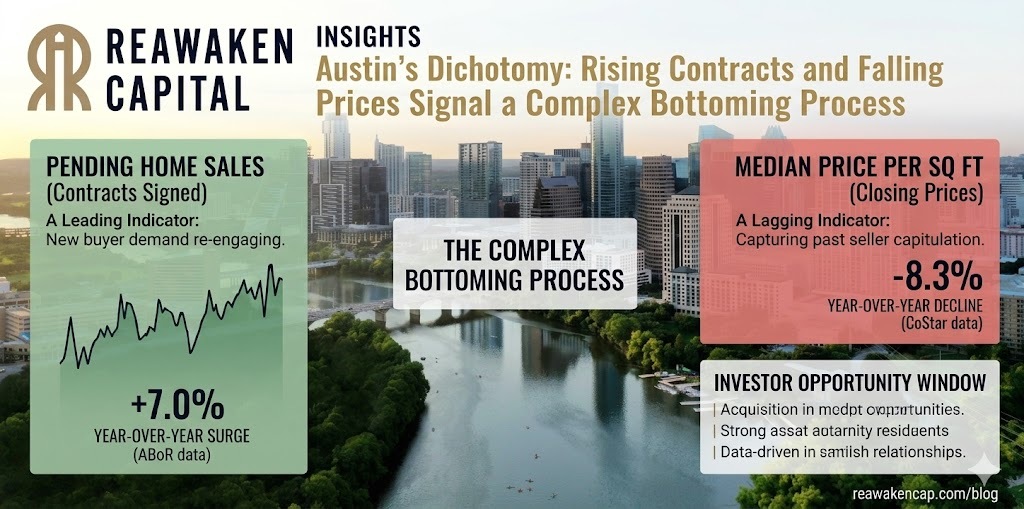
For the past 24 months, investors have watched the Austin real estate market with a mix of fascination and trepidation. The market that once defined the pandemic-era boom has since become the benchmark for the subsequent correction. Now, in mid-2026, the data is presenting a fascinating dichotomy: a market where buyer activity is rising in tandem with significant price declines. A June 3rd report highlighted a 7.0% year-over-year increase in pending home sales across the Austin-Round Rock MSA. On the same day, separate analysis from CoStar Group revealed that Austin’s price per square foot has fallen 8.3% annually, one of the most severe drops among major U.S. metros.
This is not a contradiction. It is the complex, often messy, signature of a market bottoming process. The era of uniform, upward price momentum is over, replaced by a nuanced environment where firming demand and buyer leverage coexist. For investors, this signals that the window of maximum opportunity—acquiring assets at a reset basis just as underlying demand begins to reawaken—is now open.
The Anatomy of a Divergence
To understand the current market, we must dissect the two opposing data points. They represent different stages of the market cycle playing out simultaneously.
The 7.0% rise in pending sales is a forward-looking indicator. It signifies that buyers, after a long period on the sidelines, are re-engaging with the market. This re-engagement is not driven by the FOMO that characterized 2021, but by a calculated response to two factors:
- Price Capitulation: After a protracted correction, asking prices have finally fallen to a level that buyers deem rational. The 8.3% annual decline in price per square foot is not a sign of fresh weakness; it is the mathematical reality of sellers accepting market-clearing prices.
- Rate Stabilization: While mortgage rates remain structurally higher than their generational lows, the volatility has subsided. Buyers can now underwrite a purchase with more confidence, no longer fearing a sudden spike that would derail their financing.
Conversely, the 8.3% price decline is a lagging indicator. It reflects transactions closing today that were negotiated based on the market weakness of the past several quarters. This figure captures the final, and often steepest, part of the price reset. According to the Austin Board of REALTORS (ABoR), months of supply, while down from its 2025 peak, still stands at 4.1 months. This is a far cry from the sub-one-month inventory levels of the boom but represents a market where buyers still retain considerable choice and negotiating power.
At Reawaken Capital, we view this divergence as the end of the market’s freefall and the beginning of a protracted price discovery phase. The surge in transactions is not a precursor to a V-shaped price recovery. Rather, it indicates that the bid-ask spread has finally compressed to a point where deals can happen again.
The New Underwriting: From Momentum to Fundamentals
The structural shift in the Austin market necessitates a complete overhaul of the investor playbook. The prior cycle was defined by cap rate compression and momentum; the next will be defined by operational excellence and durable rental demand.
The very forces driving the correction in the for-sale market are creating a powerful tailwind for multifamily assets. Even with an 8.3% price decline, the absolute cost of homeownership in Austin remains prohibitive for a large segment of the population, especially when factoring in a 30-year mortgage in the 6.0-6.5% range.
Consider the math for a median-priced home in Austin, which, despite recent declines, still hovers near $550,000 according to recent ABoR data. A household needs an annual income well north of $150,000 to comfortably afford such a purchase. This dynamic creates a large and growing cohort of "renters-by-necessity" and "renters-by-choice" who possess high incomes but are locked out of or have opted out of the for-sale market. This is not a short-term pricing anomaly; it is a multi-year reset that strengthens the fundamental demand for high-quality rental housing.
This sustained rental demand is occurring just as the market offers the most attractive acquisition basis in years. The negative sentiment that has blanketed Austin has caused multifamily cap rates to expand significantly. We are now seeing well-located Class B and A-minus assets trade at yields that provide a positive levered return from day one—a scenario that was virtually impossible from 2020 to 2022.
Investor Implications: A Market for Precision, Not Passive Bets
The current environment in Austin is unforgiving to passive, broad-market strategies. It is, however, exceptionally rewarding for disciplined, data-driven investors who can identify value amid the noise.
- Focus on Reset Basis: The primary opportunity is to acquire assets at a basis that reflects the new interest rate reality. The 8.3% decline in for-sale pricing is a proxy for the broader repricing that has occurred across all asset classes. Buying at this reset basis de-risks the investment and creates a foundation for future appreciation.
- Target Durable Demand: The 7.0% increase in transaction volume is the "green shoot." It confirms that Austin's core economic engine—job growth and population inflows—remains intact. The key is to invest in assets that directly serve this demographic. This means focusing on submarkets with strong employment nodes, desirable school districts, and lifestyle amenities that attract the high-earning professional renter pool.
- Underwrite for Yield, Not Hope: The era of betting on rapid rent growth and cap rate compression is over. Returns will be driven by in-place cash flow and incremental, value-add improvements. Investors must underwrite deals based on current rents and realistic operational assumptions. The rising transaction volume suggests the market is beginning to stabilize, providing a firmer floor for underwriting rental income.
The Austin market is transitioning from a period of sharp correction to one of complex stabilization. The conflicting headlines of rising sales and falling prices are not a sign of confusion, but of a market finding its footing. At Reawaken Capital, our strategy is built for precisely this type of environment. By leveraging granular, metro-level data, we can look past the sensational headlines to identify the underlying fundamentals. The re-emergence of buyers, coupled with reset asset pricing, is creating a compelling, if narrow, window of opportunity. The recovery will not be linear, but for investors with conviction and a precise strategy, the foundation for the next cycle of growth in Austin is being laid today.
Disclaimer: The information provided on our website and in our investment materials is for informational purposes only and should not be considered financial advice. We recommend consulting with a qualified financial advisor before making any investment decisions.